Mining Dust Suppression
Effective dust suppression is a critical priority for South African mines. From haul roads and crushers to transfer points and stockpiles, uncontrolled dust affects worker health, equipment, visibility, and regulatory compliance. The right spray technology makes a measurable difference—delivering better control while using less water in a water-scarce environment. Here are five proven spray nozzle types that deliver reliable mining dust suppression results.
1. Full Cone Nozzles for Broad Coverage and Material Wetting
Full cone nozzles (such as FullJet® models) produce a solid, circular spray pattern with medium-to-large droplets. This pattern is ideal for open areas and high-volume applications where thorough wetting is required.
They excel at crusher discharge points, conveyor transfer zones, loading and unloading areas, stockpiles, and haul-road surface conditioning. The uniform coverage penetrates dust clouds and adds moisture to the material itself, preventing dust from becoming airborne in the first place. In South African mining conditions, these spray nozzles offer a robust, low-maintenance option for primary dust suppression where drift resistance and broad impact matter most.
2. Hollow Cone Nozzles for Airborne Dust Capture
Hollow cone nozzles (WhirlJet®) create a ring-shaped or wide-angle pattern with finer droplets and large free-passage openings. The open design resists clogging—especially valuable when process or recycled water containing solids is used.
These nozzles are highly effective for airborne dust suppression inside transfer chutes, around crushers, at stackers and reclaimers, and in semi-enclosed areas. The finer droplets maximise contact with suspended particles while the clog-resistant construction keeps systems running with minimal downtime. Many South African operations favour this combination for reliable dust control in dusty, high dust load environments.
3. Flat Fan Nozzles for Targeted Penetration and Belt Wetting
Flat fan nozzles (VeeJet® ) deliver a controlled, linear spray pattern with strong impact. They are the preferred choice when precise coverage is needed along a specific line or surface.
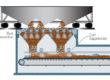
Common applications include conveyor belt wetting, chute openings, screen decks, and ore-bed penetration ahead of transfer points. The focused spray adds moisture efficiently without excessive pooling or overspray. When paired with hollow-cone nozzles in a two-layer strategy, flat fan units provide material conditioning while the hollow-cone units capture airborne particles—creating highly effective dust suppression at transfer points.
4. Fog and Mist Nozzles for Fine Respirable Dust Suppression
Fog and mist nozzles generate very fine droplets (often in the 30–100 µm range or smaller) at low flow rates, typically from 0.5 to 2 L/min per nozzle. These small droplets are excellent at agglomerating respirable dust particles (PM10 and finer) that pose the greatest health risk.
They perform best in enclosed or semi-enclosed spaces such as crusher houses, conveyor galleries, hoppers, and screening areas. Because they use relatively low water volumes, fog and mist nozzles support water-efficient dust suppression—an important advantage on South African sites facing water restrictions. Proper placement and enclosure help minimise wind drift and maximise dust control efficiency.
5. Air-Atomising Nozzles for Ultra-Fine Control with Minimal Water
Air-atomising (two-fluid) spray nozzles use compressed air and water to produce the finest droplets available. This technology is ideal when the absolute minimum water addition is required or when very fine airborne dust must be controlled in confined spaces.
Typical uses include enclosed transfer points, mill areas, and locations where product over-wetting must be avoided. The fine mist captures small particles effectively while keeping moisture addition low. Although an air supply is needed, the water savings and superior dust suppression performance often justify the investment, especially on sites prioritising both health compliance and water conservation.
Choosing the Right Dust Suppression Nozzle Combinations for best results
Successful dust suppression rarely relies on a single spray nozzle type. Most effective dust control systems combine patterns: full-cone or flat-fan units for material wetting and surface control, paired with hollow-cone, spiral, fog, or air-atomising nozzles for airborne capture. Factors such as droplet size, free-passage design, water quality, enclosure conditions, and local wind all influence performance.
In South Africa, where water efficiency, safety regulations, and operational uptime are equally important, selecting the correct spray technology delivers clear returns—lower water use, reduced health risks, better visibility, and easier compliance.
Ready to improve dust suppression performance at your operation? Contact us for a site-specific assessment. Our specialists can recommend the optimal spray nozzle combination and help you design a water-efficient system that delivers measurable results.